

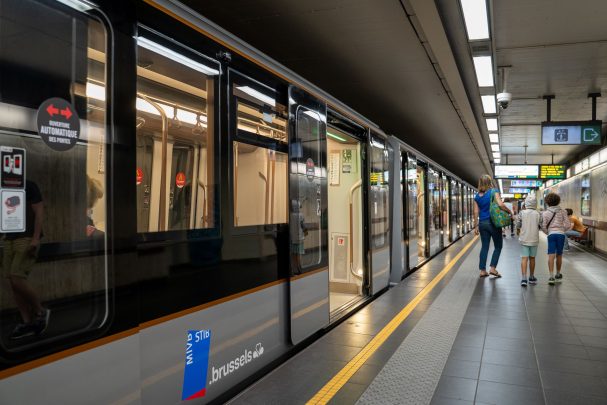
You probably know this already: as soon as the audio signal sounds to indicate that the doors are closing, you’re no longer allowed to board. But how does the opening and closing system actually work? Is it automatic? And during the COVID period, couldn’t the driver just open all doors at every stop? We explain it all here.
Bus and tram
On all our buses and trams, the doors close automatically. Passengers open the doors themselves by pressing the button. The only thing our drivers do is lock or unlock the entire system. Once the doors are locked, they cannot open between two stops — not even if you press the button. The driver can only lock the system if all doors are fully closed.
Double safety on our buses…
The automatic closing system is installed on all bus doors, except for the front door. It includes two safety features:
- Presence detection, which prevents the doors from closing when someone is standing close to them. In older vehicles, this is done using a floor sensor; in more recent ones, through infrared detection.
- Sensitive door edges, which cause the doors to reopen automatically if they detect an obstacle while closing.
The door-closing mechanism complies with European standard R107, which prescribes how doors on vehicles used for passenger transport must operate.
… and on our trams
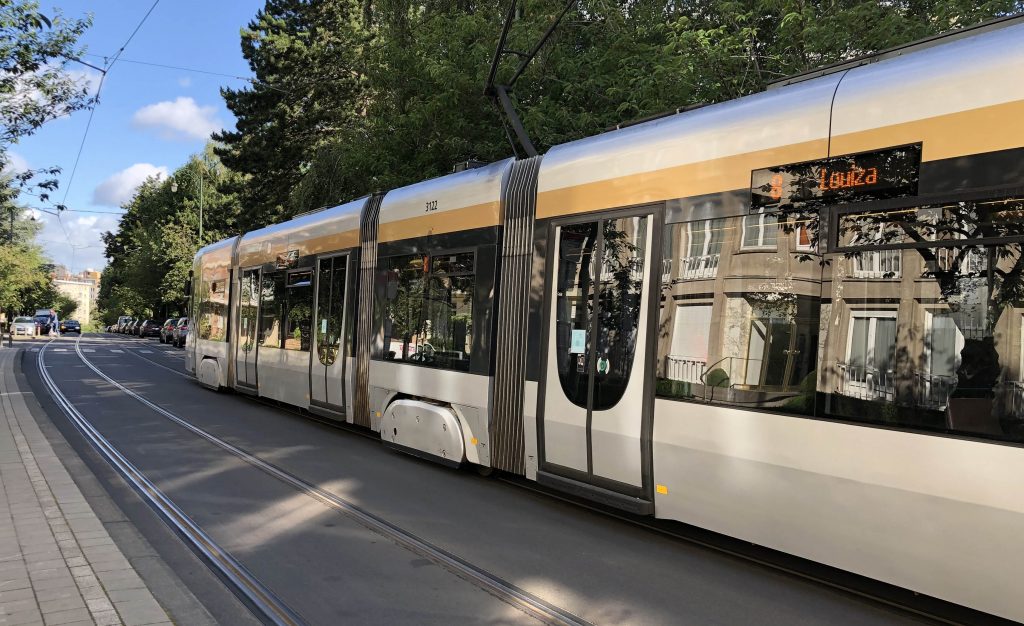
Just like on our buses, tram doors close automatically, except for the first door near the driver. Here too, two similar safety systems are in place:
- An infrared sensor detects when someone is standing close to the door. If that’s the case, the doors won’t close automatically.
- A sensitive edge causes the doors to reopen if an obstacle is detected during closing.
Here too, a European standard defines how the doors must operate. Standard EN14752 more specifically prescribes the functioning of doors on rail-based passenger vehicles.
Note that T2000 trams have no presence detection. Their doors close automatically after 20 seconds — which is why respecting the audio signal is so important.
The metro
In the metro, it is not possible to open all doors automatically at once — except on the new M7 trains. The driver can only decide to lock or unlock the door system, but the passenger decides whether or not to open the door. If no one gets in or out at a particular door, it simply stays closed.
On our new M7 metro trains, the doors open and close fully automatically. You no longer need to press a button — the doors open (and close) by themselves at every station. So make sure you don’t lean against them!
Snowball effect
Metro regulation follows a precise timetable, like a metronome. A screen at the end of the platform informs the driver whether they are on schedule. Once the driver triggers the audio signal for door closing, no passenger can board safely anymore.
Now imagine we allow just one extra person to board (15 seconds), then another because someone suddenly appears, and do this at every station… That train would never get back on schedule. Worse: it would delay all following trains.
During peak hours, metro trains run every 180 seconds. With such a frequency, it is simply not possible to wait longer at stations to allow late passengers to board, because the next train is already so close. Things are different in the evening, when the frequency is lower and drivers can allow a late passenger to board.
Punctuality of the metro
Sometimes passengers take risks to help others get on board — and it may seem like a kind gesture. But delaying a vehicle affects an entire metro line or tram line. Not very considerate, is it? Waiting a few minutes for the next vehicle prevents accidents and delays. Passengers wait for the metro. Not the other way around.
This may sound harsh, but think about it: if the metro had to wait at every station for people who want to jump in at the last second, it would never leave. You can easily imagine this at Gare Central/Centraal Station or Arts-Loi, where huge numbers of passengers get on and off.
In reality, a metro is supposed to stop for only 16 seconds per station:
- 3 seconds for the doors to open
- Boarding and alighting
- 3 seconds for the audio signal
- 3 seconds for the doors to close
- 2 to 3 seconds of safety checks before departure
Contrary to what you might think, metro and tram doors are not like elevator doors that reopen at the slightest resistance. They exert strong pressure. They can cause injuries, not to mention the damage if the vehicle departs while an object is stuck between the doors.
What looks harmless at first sight can go very wrong: not only for you, but also for other passengers on the platform who could be hit by the blocked object.
Do not block the doors
Whether you’re taking a tram, bus or metro, the same basic rule applies: do not block the doors. The rule is simple: once you hear the audio signal, do not board or alight anymore. Blocking the doors not only disrupts the network (and causes delays across the whole system), it also puts your own safety at risk!