

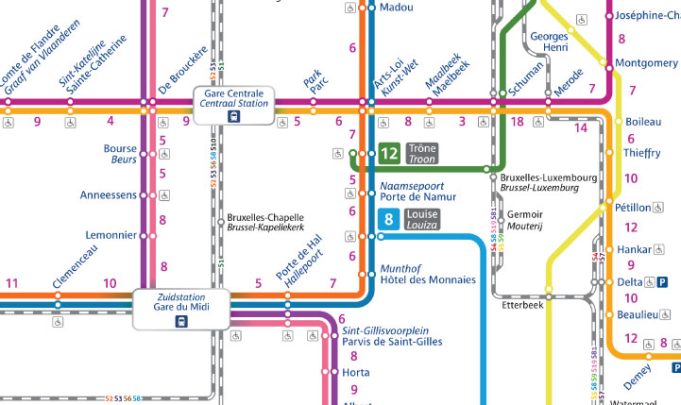
Have you ever taken the metro in Brussels from Central Station/Centraal Station to De Brouckère or Sainte-Catherine/Sint-Katelijne? Did you know that theose two stations are only about a 15-minute walk apart? Whether you need some fresh air, want to avoid a transfer by walking, or simply want to stretch your legs, with our “walking map” of the Brussels metro you can discover the city… on foot!
In Brussels, everything is often closer than you think, and behind every street corner there’s a piece of history or a work of art. Choosing a short walk between two stations is a great opportunity to experience the city in a different way.
Moreover, the distances between stations are often shorter than you might expect. For example, it takes less than 10 minutes to walk from Arts-Loi/Kunst-Wet to Maelbeek/Maalbeek, and barely 6 minutes from Porte de Namur/Naamsepoort to Louise/Louiza. With this map, you can easily visualise how much time you need to walk parts of the STIB-MIVB network and add some variety to your daily journeys.
Want to avoid a transfer? Then a short walk can simplify your journey. If you are, for example, at Parc/Park and need metro line 2 or 6, you only need to walk 6 minutes to Arts-Loi/Kunst-Wet. Or if you are at Yser/IJzer and want to take tram 4 or 10, a 5-minute walk to Rogier will get you on your way more quickly, and you may even save a bit of time.

Walking routes full of discoveries
Don’t feel like waiting for the metro? Why not pretend to be a tourist for a moment? By choosing a short walk, you’ll discover plenty of beautiful sights along the way:
- Central Station/Centraal Station → Sainte-Catherine/Sint-Katelijne (15 minutes)
Enjoy the stunning Royal Saint-Hubert Galleries and the atmospheric pedestrian streets in the historic city centre.
- Parc/Park → Trône/Troon (7 minutes)
Cross the magnificent Parc de Bruxelles/Park van Brussel and admire the impressive façades of the Royal Palace.
- Merode → Schuman (15 minutes)
This short walk takes you through the Cinquantenaire Park, where you can also visit the Royal Museums of Art and History.
You can even turn it into a sporty challenge by alternating between metro and running! Some of our colleagues ran various routes to prepare for the 20 km of Brussels.
The impact on mobility, environment and health
Opting for walking as a means of transport also means taking a step towards a better environment. Every trip you don’t do by car contributes to reducing CO₂ emissions. This way, you help make Brussels more sustainable and pleasant.
In addition, walking is extremely good for your health! A mere 30 minutes a day already helps reduce the risk of high blood pressure and heart disease and improves your blood circulation. Walking is not only good for the heart, but also for the mind: it stimulates the production of endorphins, the well-known ‘happiness hormones’ that reduce stress and improve your mood. Unlike more intense sports, walking is also gentle on the joints while strengthening the muscles in your legs and back. And if you have trouble falling asleep, know that walking in the fresh air can significantly improve your sleep quality by regulating your natural day–night rhythm. Another good reason to get moving more often!
Walking between two stations: a smart choice
In short, alternating walking with the metro is not only practical but also a chance to discover Brussels in a new way, at your own pace. By using public transport for longer distances and walking the shorter stretches, you get to know the city better: its alleyways, lively squares and hidden gems… all while taking good care of your body!
So, why not give it a try?