

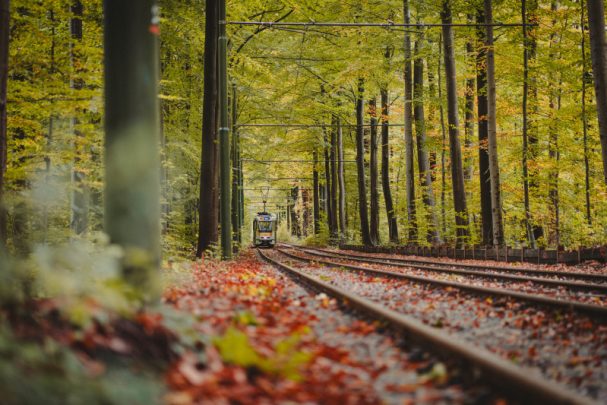
Brussels is one of the most forested cities in Europe. You’ll find a wide variety of trees here, including along our tram network. In autumn, they enchant our passengers with their beautiful colours. Wonderful to look at, but the season also entails risks. Rain and mist reduce visibility, and dead leaves falling on our tracks make roads and rails dangerously slippery. Why does this matter to us? We explain in detail.
The braking distance of our trams
In autumn, temperatures drop. It rains more often, mist forms, and darkness sets in earlier. In short, visibility decreases. On top of that, many dead leaves fall to the ground and are blown into piles by the wind. It’s a period during which both our drivers and our passengers need to be extra careful.
The wheels of our trams press these piles of leaves together on the tracks. This creates a kind of film, a mush that makes the rails very slippery—especially after rainfall. Driving and braking on dry dead leaves, on the other hand, produces smoke. In both cases, the tram has much less grip and takes longer to come to a stop.
This is a challenging time for our drivers. That’s why it’s important to raise awareness among our passengers and among other, especially vulnerable, road users. Our latest campaign reminds you that the tram always has priority!
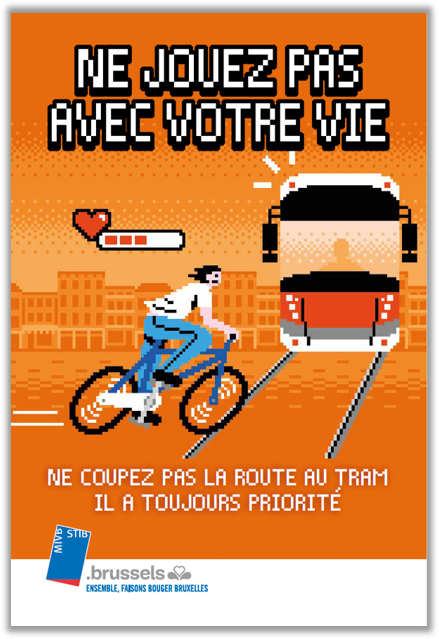
This priority exists for a reason. A tram has metal wheels running on metal rails and, even without dead leaves, needs a much longer braking distance than a vehicle with rubber tyres. A tram travelling at 40 km/h needs around 40 metres to stop. In rain or when leaves cover the tracks, this distance increases considerably. And unlike other vehicles, a tram cannot swerve if someone suddenly appears right in front of it.
Hunting down the dead leaves
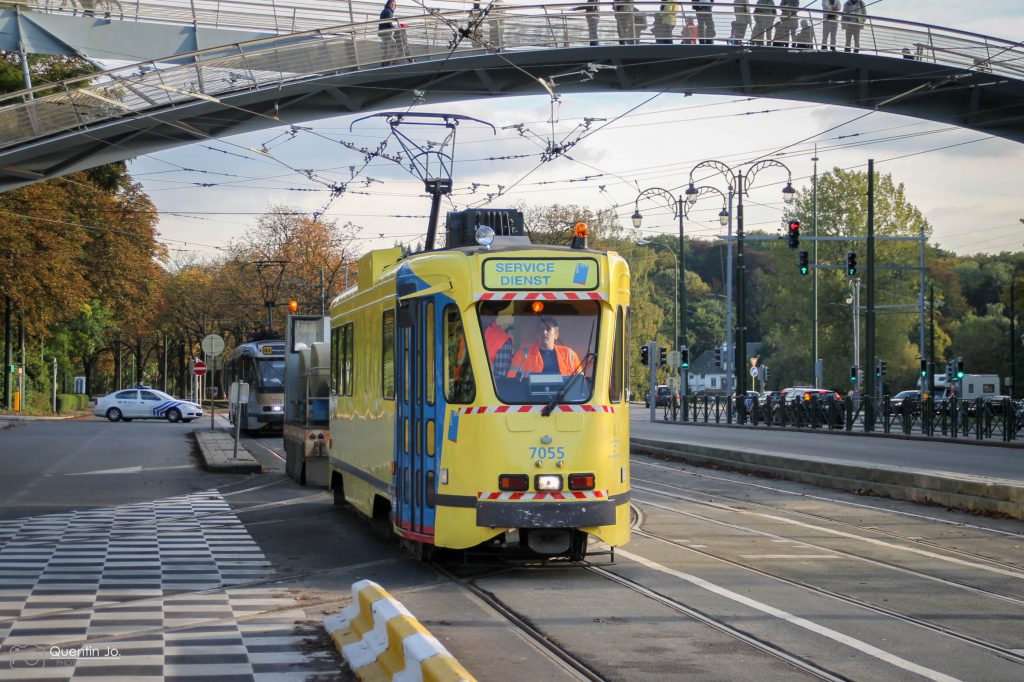
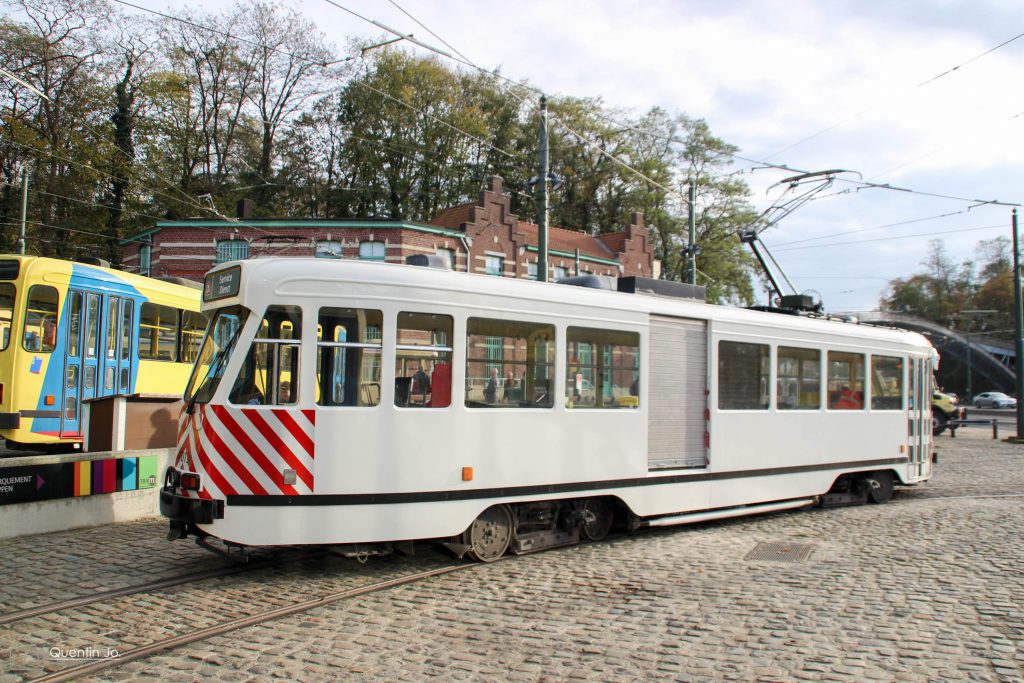
STIB-MIVB can rely on several special vehicles in its battle against fallen leaves. At night, when regular trams are in the depot, tram 7055 heads out. It pulls a machine that sprays high-pressure water onto the tracks. This cleans the rails and removes dead leaves. This tram mainly operates on lines 7, 8, 19, 39, 44, 82 and 93—our most “wooded” routes, and therefore the most affected by the phenomenon.
Our T3000 and T4000 trams also detect when they’re losing grip and automatically spread sand in front of their wheels. This improves traction and shortens braking distance, even when leaves are falling. On older trams, or when the driver senses reduced grip, they can also decide themselves to release sand.
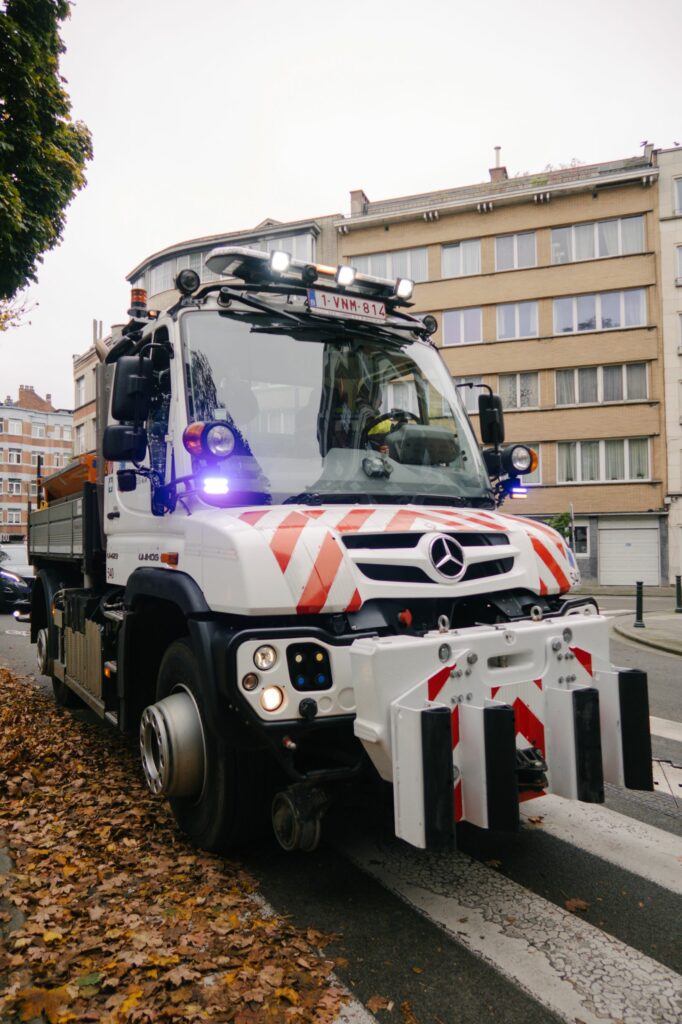
We also rely on Bruxelles-Propreté for support. In collaboration with them, we look into whether intervention is needed during the day as well. Bruxelles-Propreté can then quickly step in to clear tracks covered with dead leaves.
Limited visibility
Autumn is also the season when visibility can be severely reduced. Dusk—sometimes combined with rain… or worse: fog!—creates dangerous conditions. Passengers who suddenly appear out of nowhere or who are distracted are a tram driver’s nightmare. They can’t swerve and must take into account a long braking distance.
Unfortunately, our drivers experience this often: a pedestrian walking while staring at their smartphone, a cyclist crossing at the very last second, or someone who puts up their hood in the rain and can barely see what’s happening around them… Imagine sitting in the driver’s cab knowing you can’t swerve and cannot stop within a few metres.
Tram driver Yassine recently sent us a message about this. He was worried.
“Could you ask passengers to be extra alert? There’s been a lot of fog lately and people don’t see the tram coming. As a driver you get chills down your spine. It’s all we talked about at the depot.”
So stay alert!
Did you know?
We don’t rely on campaigns alone, we also implement many other measures. Tram drivers receive extensive training, with a strong focus on defensive driving and accident prevention. Warning signals are systematically used when arriving at and departing from stops, and adjustments are made in areas prone to accidents. These include clear road markings, flashing lights, special pedestrian crossings, and more.