
Although driving a bus or tram may look easy, the reality is quite different. It takes more than six weeks of theoretical and practical training, plus several exams, to become a true “star of the STIB-MIVB network”. Which steps do you have to go through as a candidate driver? And what does a bus and tram training look like at STIB-MIVB? We’ve sorted it out for you
Applying at STIB-MIVB
A great tram or bus driver needs to be someone with specific qualities. You must be resilient under stress, flexible, and enjoy interacting with passengers. Does that sound like you? Then apply via our website: https://jobs.stib-mivb.be. (Yes, you will need to know French and/or Dutch, to apply as well as to succeed. So, the job pages are restricted to both languages).
Once your CV has been reviewed and accepted, you’ll receive an invitation to the tests. The first one is a reasoning test on the computer, followed by a personality questionnaire. You’ll need to pass these to move on to the next stage. If you do, you’ll be invited for an interview with a recruiter.
To become a bus driver, you must also take and pass a traffic rules exam. Finally, you’ll undergo a medical check-up before signing your contract and starting the training.
Tram Driver Training
If you are selected to become a tram driver, you’ll follow a training programme lasting around 30 working days, or 5 to 6 weeks.
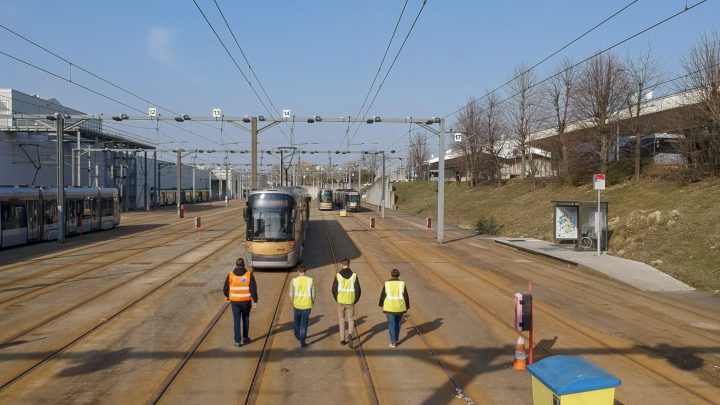
Your journey begins with an introduction to the tram: discovering the driver’s cab, the different controls, driving a first short distance, and other initial preparations.
At the same time, trainers provide a series of theoretical courses, especially during the first two days. You’ll learn the traffic rules — and discover, for example, that trams do not follow the same highway code as other vehicles but instead apply their own specific rules. A tram is, after all, a rail vehicle with unique characteristics. You will then acquire all the technical and technological knowledge needed for the different tram models: how they work, the driver’s cab, brake types, and more.
Because STIB-MIVB operates two main types of trams, there are two types of training programmes: one for PCC trams and one for low-floor trams. PCC trams are the older models, such as the ones used on line 51. Low-floor trams are the more modern T2000 (line 62), T3000 and T4000 (lines 3 and 4, for example).
The technology of these two types of vehicles differs greatly, and so does the training. This means that any driver switching from a PCC to a low-floor tram, or vice versa, must undergo new training.
Exams
After two days of theory, you will receive a first list of 40 practice questions to prepare for the upcoming exams. Passing these exams is essential to continue the training.
You will then spend a day in the simulator. STIB-MIVB has three simulator rooms for PCC and low-floor trams. There you learn how to troubleshoot a tram — a crucial skill, since drivers must be able to fix minor issues themselves. During the simulator sessions, you will also learn how to contact the dispatching centre in case of a simulated breakdown.
From the second day onward, you’ll start driving on the network from the Haren depot. At the same time, the practical and theoretical training continue:
- Accident simulation on the network
- How to contact dispatching
- Staying focused while driving
- How to couple a tram
- Ticketing procedures
- Administrative tasks (service sheets, personal STIB-MIVB file, …)
- Tunnel evacuation (see our “EvacTunnel” article)
- …
Throughout the programme, you’ll take various exams and driving tests. The bar is set relatively high: failing one exam means you have to leave the training… But the good news is that 9 out of 10 candidates pass.
In the final week, you’ll drive on the network with an instructor – just like in real life, with passengers on board.
PCC or Low-Floor Tram: Which Training Will You Get?
This depends on the depot where you will be assigned to and the depot’s operational needs. It’s essentially a matter of “luck” or “coincidence”. And even if some drivers prefer one tram type over the other, versatility is essential: eventually, everyone will be trained on both.
With the arrival of our new tram — the TNG (Tram New Generation) — we are also preparing our drivers accordingly. These new trams are far more modern and digital! Our trainers are already studying a thick syllabus, and a brand-new simulator is under construction.
Bus Driver Training
Bus training may look simpler, but that’s certainly not the case. To become a professional driver, you must hold a Certificate of Professional Competence. STIB-MIVB gives you the opportunity to obtain it if you don’t already have one.
Like tram training, bus training lasts about seven weeks. You immediately begin driving a real bus equipped with dual controls, just like at a driving school. Trainers and instructors deliver the practical lessons. At STIB-MIVB, instructors guide you on the network and teach you the routes, the specific lines, and more. And although we provide driving lessons, we are not a driving school — we are a training centre.
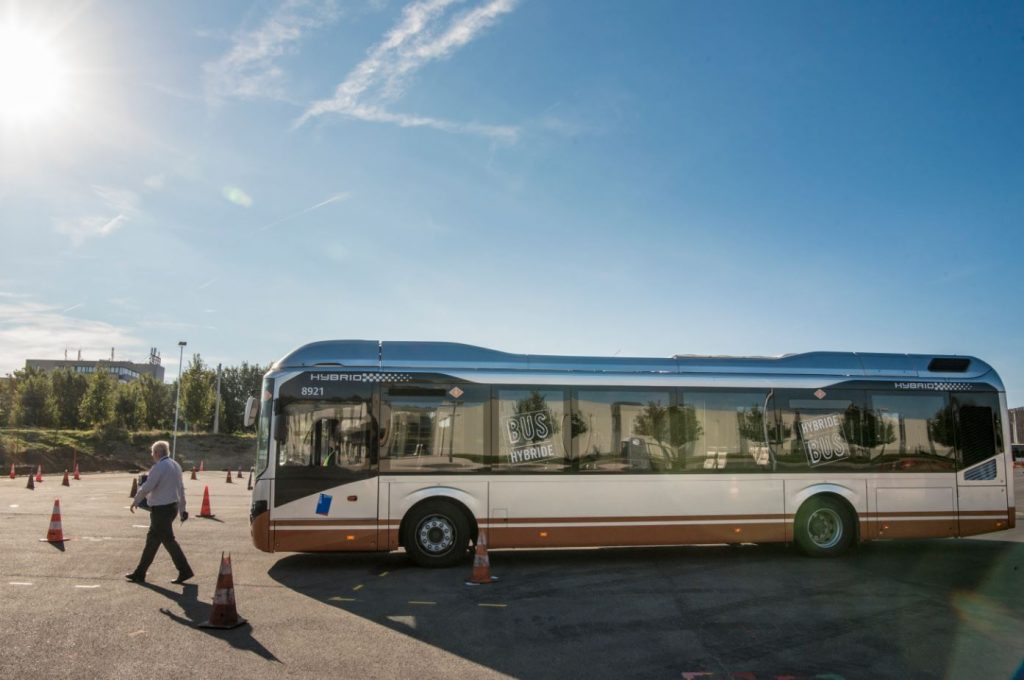
During the first 14 days, you practise manoeuvring and getting a feel for the bus on a dedicated training site. You also receive theoretical lessons. Each day consists of half a day of theory and half a day of practice. The structure is similar to tram training: a welcome session, theory courses about STIB-MIVB vehicles and traffic rules, and the first practical tests on a standard bus at our Haren depot. The training site includes cones and obstacles placed close together to help future drivers learn how to manoeuvre a bus precisely.
At the same time, our training centre administers various theory and driving exams. Just like for tram drivers, you must pass or leave the programme. For bus drivers, these exams are organised by Brussels Mobility (GOB).
Professional Competence
On day 14, candidates take the “professional competence” exam on manoeuvres and basic skills. If successful, you will head out onto public roads from day 15 for eight days. Then, on day 27, comes the “city exam”, during which examiners accredited by Brussels Mobility evaluate your driving behaviour. At this stage, if you passed all previous tests, you can obtain your category D driving licence.
But the training doesn’t end there. You still need to learn all the STIB-MIVB-specificities: administrative tasks, all types of tickets, the service sheet, … STIB-MIVB also offers many additional modules, such as the Alterno course (for handling diversions) or training on new vehicle types (such as hybrid or electric buses).
Just like tram training, 9 out of 10 candidates pass the bus training – a very encouraging result! Every year, we train hundreds of drivers. In 2020, 284 people followed the course, and 252 of them became bus drivers.
Apply at STIB-MIVB!
Have we convinced you to apply as a bus or tram driver? We took on the challenge ourselves: we stepped into the simulator and the driver’s cab, went behind the scenes, and tested everything on the field.
Straight from the heart of our social media team: hats off to our drivers. Try navigating a 75-ton vehicle through Brussels traffic…