
In 2026, the Brussels metro celebrates its 50th anniversary: half a century of history, anecdotes and daily journeys for generations of passengers. Since the first kilometres were inaugurated in 1976, the metro has grown along with Brussels and the evolution of the city and its inhabitants. Behind the platforms, metro trains and connections also lies a human, technical and cultural adventure. Step aboard for a journey through time… with no need to change at Arts-Loi.
From premetro to metro: a timeline
-
1926
The first plans for a Brussels “urban railway” begin to emerge.
-
1957
Brussels gets its first stretch of underground tramway: the Constitution tunnel, with Lemonnier station and a connection towards Gare du Midi.
-
1969
King Baudouin inaugurates the first premetro line between De Brouckère and Schuman. In the years that follow, the premetro network is gradually expanded.
-
1976
On 20 September, King Baudouin inaugurates Brussels’ very first true metro line. It connects De Brouckère to Merode, before splitting into two branches towards Tomberg and Beaulieu.
-
1985
The metro grows quickly. More than ten stations have already been added, connecting more and more Brussels neighbourhoods.
-
1988
The premetro line along the Small Ring (la Petite Ceinture) becomes metro line 2, running between Simonis and Gare du Midi. To the east, the line now extends as far as Stockel.
-
2000
New extensions bring the metro to several new destinations, including Bizet, Clemenceau, Roi Baudouin and Erasmus.
-
2009
The metro loop is completed via Delacroix, Gare de l’Ouest and Beekkant. The network takes on its current structure, with lines 1, 2, 5 and 6.
The construction of the metro
Building a metro in Brussels is about much more than simply digging a tunnel and laying two tracks. The Brussels subsoil is complex: fragile, sandy, full of water and, at times, highly unpredictable. To make progress, engineers had to adapt their methods to the terrain and to the constraints of a fully built city above their heads. Part of the routes followed existing railway infrastructure, but crossing Brussels from west to east required far more ingenuity.
Some of the techniques used seemed to be copied straight from a movie scenario. One method involved building walls first, next placing a slab above them and only then digging underneath. In other words, there was already a “roof” before the work had really begun. Another technique involved freezing the ground, enabling workers to dig through soil made firmer by the cold. This created striking contrasts in 1976: during one of the hottest summers of the 20th century in Belgium, some people were working in almost polar conditions. Beneath the Côte d’Or factory, between the frozen ground on the one hand and the smell of chocolate on the other, the site is even said to have been nicknamed “Dame blanche”. It is hard to imagine a more typically Brussels anecdote.
The keys to the metro
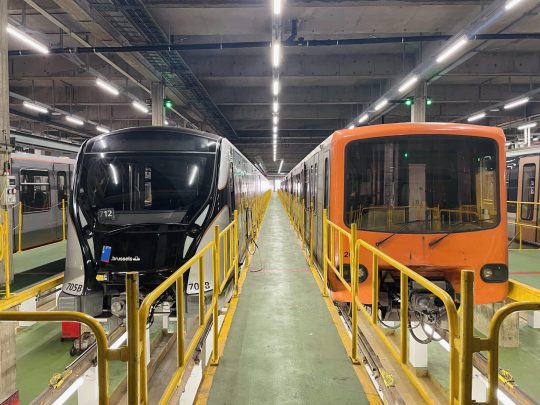
Before the Brussels metro could carry passengers, it also had its share of improvised solutions. In 1974, STIB’s first MX metro train, number 101, arrived at Delta depot. It attracted quite a crowd: everyone wanted to discover this modern orange metro train, which would later become a familiar sight on the network. There was just one problem: when they tried to open it… they couldn’t. A padlock was blocking access, and the manufacturer had forgotten the keys.
The solution? Saw through the padlock there and then. To admire the interior, the guests even had to climb in using a ladder. Shortly afterwards, train 102 arrived too, but with no locomotive available, staff moved it through the depot by themselves. The early years of the Brussels metro had their fair share indeed of improvisation, resourcefulness and rolled-up sleeves. Fortunately, things ran more smoothly afterwards: the MX trains would become a well-known part of metro history, and some of them are still in service on the network today.
Inauguration day
On 20 September 1976, Brussels did not simply discover a new mode of transport: the city was buzzing with celebrations and activities. Sixteen stations were inaugurated on the same day, and the whole city joined in the festivities. Street theatre, concerts, markets, entertainment: Brussels rightly celebrated its metro as a new milestone in its history. For the occasion, Toots Thielemans even composed a special song, “Metro”, the ideal Brussels soundtrack for this historic day.
King Baudouin was the first official passenger, departing from De Brouckère towards Beaulieu. Each time he entered a new municipality, he briefly stepped out to greet the mayor. This protocol, typical of the era, was also highly symbolic: Brussels was entering the age of the “real” metro. That day, the capital exchanged an underground network under construction for a working metro, ready and eager to become part of everyday life.
A developing network
At the start, the line inaugurated in 1976 formed a kind of Y shape: a common trunk followed by two branches that strongly resembled a goose foot. And that goose foot would soon grow longer. The network was extended towards Sainte-Catherine/Sint-Katelijne and Demey. Then, in the 1980s, no fewer than 19 new stations opened their doors. In 1988, line 2 became a metro line on the Small Ring, between Simonis and Gare du Midi, before the loop was completed as far as Gare de l’Ouest.
Over 50 years, the metro has grown considerably in scale. What started off with 11 kilometres of network and 16 stations has become a major axis of Brussels mobility. Today, STIB has 4 metro lines and the metro network stretches over around 40 kilometres. You could certainly say that the little goose foot of the early days has grown quite a bit. And the metro continues to fulfil its main role: connecting Brussels quickly and efficiently.
Art in the metro
Even during the design phase of the Brussels metro, the aim was never to create cold and anonymous stations. Quite the opposite: in the 1960s, the designers imagined an open, lively and original underground network, with each station having its own identity through its shape, materials, colours or finishes. Art was therefore part of the project from the very beginning: a way of making the spaces more human, giving the stations a soul and offering passengers more than just a place to pass through. Today, more than 90 permanent works of art adorn the platforms, corridors and ticket halls of the Brussels metro. Paintings, sculptures, photographs, stained-glass windows, works in steel, bronze, glass or wood: underground Brussels adds a generous dose of art to your daily journeys, sometimes without you even noticing.
That is precisely what makes the Brussels metro so special. Every station has a surprise in store: the multicoloured tulips at Sainte-Catherine/Sint-Katelijne, the hanging sculptures at Comte de Flandre/Graaf van Vlaanderen, the large photographs at Gare de l’Ouest or the feeling at Alma that you are walking through a forest. Some works cover an entire wall; others are discovered in a detail, a pattern, a play of light or a material. In this way, the network becomes an art gallery accessible to everyone, no booking needed, no queue at the entrance, and a metro train every few minutes.
A placet hat is lived in
The Brussels metro is not just some place where you wait for your train while staring at the arrival time. It is also a film set, a meeting place, a regular stop on the way to the city’s big moments. Some stations have become recognisable for their architecture, their atmosphere or their highly photogenic character. Pannenhuis, for example, with its seventies look, oval shapes and orange accents, even served as the setting for a music video by Belgian DJ Henri PFR.
The metro also makes outings, concerts, matches, festivals and major Brussels events possible. In 2024, STIB enabled more than 1.65 million journeys to concerts and events, sometimes using additional measures such as shuttles, increased frequencies and Event Passes. And then there are all the unexpected stories that no timetable can predict: a meeting, a lost and then found item, a cat on a metro train, or even a baby born at Beekkant, after which the stop was nicknamed “Babykant” for the occasion.
Fifty years after its inauguration, the Brussels metro still does far more than merely carry passengers. It tells the story of a city, its challenges, its evolution, its major events and its small, unexpected moments. An underground story that we cross every day… without always knowing everything that lies behind it.