

We’ve all thought it at some point, quietly or sometimes out loud: “If only I’d taken the car.”
A delayed tram, an unexpected downpour, a bus that’s just a bit too crowded… and suddenly the car feels like the obvious solution, as if it only costs a bit of fuel.
But in a city (and definitely in Brussels), a car is above all a sum of fixed costs – even when it’s just standing still. In this blog, we do something we don’t often do: we compare the cost of a car with that of an STIB-MIVB monthly pass, to see what travelling in Brussels really costs.
Before we start, some concrete figures:
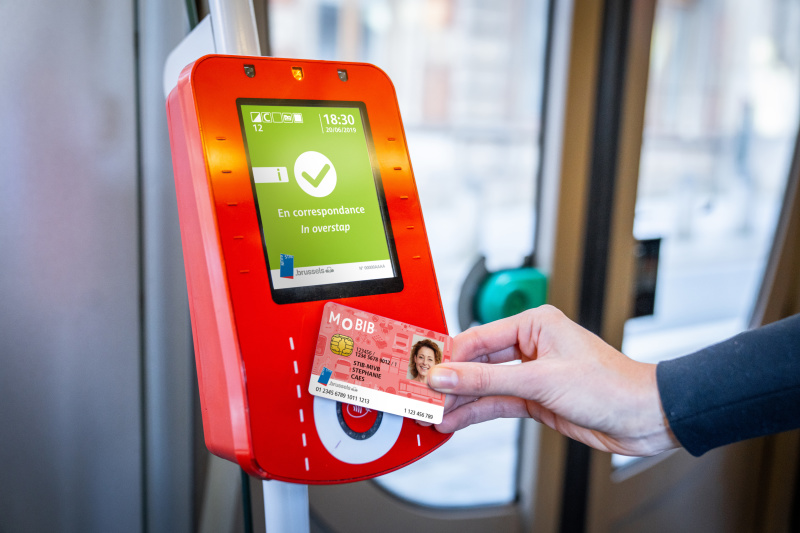
- An STIB-MIVB monthly pass costs € 56 (an annual pass € 560).
- A single STIB-MIVB ticket (one journey) usually costs € 2.70 via the app, ticket machines or sales points. Contactless payment (bank card/smartphone) costs € 2.40.
- Owning a car in Brussels means taking into account annual road tax and registration tax (one-off), as well as insurance, maintenance, parking, fuel, etc.
- In Belgium, people often cite an average of around € 400 per month for fuel, insurance, taxes and maintenance (and that is without including the purchase price of the car).
Why the car seems cheaper than it really is
A car often looks affordable thanks to one remarkable talent: it hides its true cost very well. Unlike a transport pass, you don’t pay everything at once. The expenses are spread out over time… and therefore less visible.
But even when it’s parked, a car continues to cost money: insurance, taxes, minimum maintenance, depreciation over the years and, in the city, parking costs. A cost that is often underestimated, but very real.
And as soon as you start driving, the bill keeps adding up: fuel or charging, paid parking, possible fines, and normal wear and tear on parts such as tyres and brakes. The more you drive, the more these variable costs increase.
That’s exactly why the comparison with an STIB-MIVB pass is so relevant. For € 56 per month, your budget is clear, stable and predictable. With a car, that’s far less the case.
Travelling in Brussels by car or by public transport: what does it really cost?
Owning a car in Brussels comes with specific urban and regulatory costs. Taken separately, they may not seem excessive, but together they weigh on your budget, sometimes without you really realising it.
- Annual road tax: depends on the car’s power. As an indication, this is around € 186 per year for 6 hp and € 243 per year for 7 hp, even if the car isn’t used.
- Vehicle registration tax: a one-off cost, but highly dependent on the vehicle. It can range from € 75 to several thousand euros, depending on power and age.
- Parking: depending on the municipality and household situation, a resident parking permit can cost from a few dozen euros to more than € 100 per year – and more for a second car. For short-term parking: two hours in an underground car park in the city centre can easily cost around € 7.
- LEZ rules: since 2026, certain vehicles are no longer allowed to drive in Brussels. After a transition period, a fine of € 350 may apply in case of non-compliance.
Viewed separately, these amounts may seem reasonable. But on average, a “standard” car in Brussels quickly comes to around € 390 per month (without a private garage or parking space).
In comparison, the STIB-MIVB pass costs € 56 per month. The gap therefore remains particularly large when you compare the real monthly budgets.
The real advantages of the car (and the limits of public transport)
Comparing car and public transport only makes sense if you stay honest and nuanced. In Brussels, each option has its strengths and its limitations, depending on use and timing.
- The car is practical: for door-to-door trips, carrying shopping or equipment, routes with little or no public transport, late-night travel, carpooling, or leaving Brussels towards areas with limited public transport.
- The car complicates life: with high annual costs, maintenance, time and money spent on parking, traffic jams, stress caused by congestion and searching for a parking space.
- The STIB-MIVB pass is cost-effective: a clear budget, no parking stress, often smoother travel in a busy city.
- The STIB-MIVB pass has its limits: sometimes transfers are needed, frequencies vary, and comfort depends on crowding.
In practice, many Brussels residents opt for a balance: public transport for everyday life, and when a car is really needed, an ad-hoc solution such as car sharing in Brussels. A choice that often helps keep the budget under control.
So… should we have taken the car?
When comparing car and public transport, the same questions always come up. “If the car is already paid for, does it still count?” The answer is: yes. Even without a loan, insurance, taxes and maintenance continue. And over time, expect rising costs for wear and repairs. Those costs don’t disappear.
If you drive little, you may feel like you’re saving money, but that mainly reduces fuel costs. Fixed costs stay the same, which often causes the real cost per kilometre to rise. Conversely, if you only use public transport occasionally, you may be better off with options such as the daily cap of €8.50 (with contactless payment) rather than a monthly pass.
In the end, it’s not really about “car or public transport”, but about how much we’re willing to pay to keep a car available… even when it’s not being driven.
A word to the wise… 😉
Want to know more?