
Every year on 3 December, the International Day of Persons with Disabilities reminds us of the importance of accessibility. It is the perfect moment to reflect on the progress Brussels public transport has made, as well as the concrete steps it still aims to take. To achieve this, STIB-MIVB works closely with the Brussels Region and with advocacy groups.
Summary
- What exactly is “accessibility”?
- Passenger information
- Stations and stops
- Vehicles: bus, tram and metro
- Other solutions specifically for people with disabilities
What exactly is “accessibility”?
You are considered a person with reduced mobility when moving around is more difficult due to your height, condition, age, permanent or temporary disability, or because you need mobility aids. So this does not only refer to people with a permanent disability, but also, for example, to someone temporarily less mobile due to surgery or a fracture.
This means that we must first take into account what people need – starting with people with disabilities, whose needs are often the greatest. To achieve this, STIB-MIVB aims to improve “accessibility”: enabling access to public transport and to our infrastructure.
STIB-MIVB formalised this commitment to improving accessibility in 2013, when it proposed including it in the public service contract: “STIB-MIVB accepts the general principles of the UN Convention on the Rights of Persons with Disabilities.”
The overall objective is to aim for full autonomy wherever possible and to provide additional support for complex situations, where full autonomy cannot be achieved.
The 2019–2023 public service contract therefore included a ‘Strategic Plan for Improving Accessibility’. Many mobility stakeholders contributed to this document. It reinforces and better structures STIB-MIVB’s commitment to developing and promoting accessible public transport.
This strategic plan comes with an unprecedented governance approach that brings together the entire chain of responsibility and influence: from the cabinet of the Brussels Minister for Mobility, to the organising authority (Brussels Mobility), to STIB-MIVB itself, and through CAWaB (“Le Collectif Accessibilité Wallonie Bruxelles”, the Brussels–Wallonia accessibility collective), right up to the users. Thanks to this organisational approach, we can follow a tried-and-tested recipe: continuous dialogue between all stakeholders.
Work areas
Improving public transport accessibility means acting across several domains:
- Passenger information
- Stations and stops
- Vehicles
Over the past years, many improvements have been made for public transport users.
Passenger information
Les sources digitales d’information
Providing reliable and high-quality information is essential for passengers with reduced mobility, especially because they need to prepare their trips.
A dedicated page on the STIB-MIVB website gathers all key practical information and offers useful tips and tricks. Did you know that the STIB-MIVB website received the AnySurfer label and is therefore fully accessible?
When travelling, it is best to use the STIB-MIVB app or website. These allow you to search for accessible routes by selecting “step-free journey”. You can also find real-time information on the status of lifts and escalators—a crucial feature, as a station is often inaccessible when a lift is out of service. That’s not something you want to discover only once you’ve arrived.
Information on the outside and inside of vehicles
It is essential to have reassuring information during your journey, such as: “Am I on the right bus?” or “Where exactly do I get off?”. Written information has existed for a long time. By adding audio announcements, accessibility increases significantly. Combining different types of information benefits far more passengers—for example, people with visual impairments or those who cannot read. STIB-MIVB buses, trams and metros are therefore equipped with onboard audio announcements. Since 2020, the entire fleet has been fitted with these.
When several lines pass at the same surface stop, or when you cannot see the line indicator at the front of the vehicle, problems may arise. STIB-MIVB therefore progressively equips buses and trams with external audio announcements. Loudspeakers announce the arrival of the vehicle, the line number and its destination. Since mid-2022, 55% of buses and trams have been equipped with these.
AccessiBus shows the accessibility level of stops
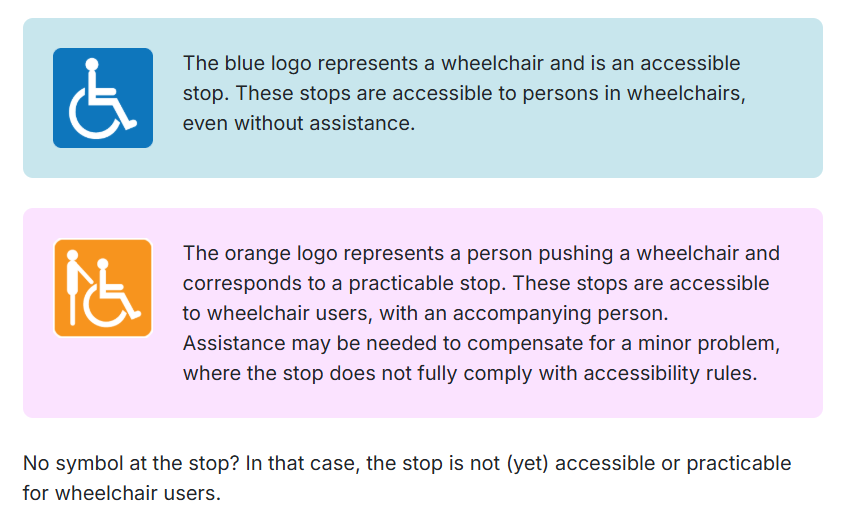
AccessiBus uses a simple system of coloured logos to show whether a stop is accessible (blue logo) or practicable (orange logo). This system helps wheelchair users plan their routes more effectively. Based on their needs, they can determine at which stops they can board or alight.
AccessiBus has been deployed across the entire bus network: since 2021 for daytime lines and since 2023 for the Noctis network.
AccessiTram for the accessibility of our tram network
Following the bus network, the tram network earned the “AccessiTram” label on 30 April 2024, on the International Day of Mobility and Accessibility. Passengers with reduced mobility can check at stops, on the website and in the STIB-MIVB app which
tram stops are fully accessible independently, accessible with assistance, or not accessible at all.
The principle is exactly the same as AccessiBus: a blue logo means ”fully independently accessible”, an orange logo means ”accessible with assistance”, while the absence of a logo means that it is not accessible.
Stations and stops
Stations
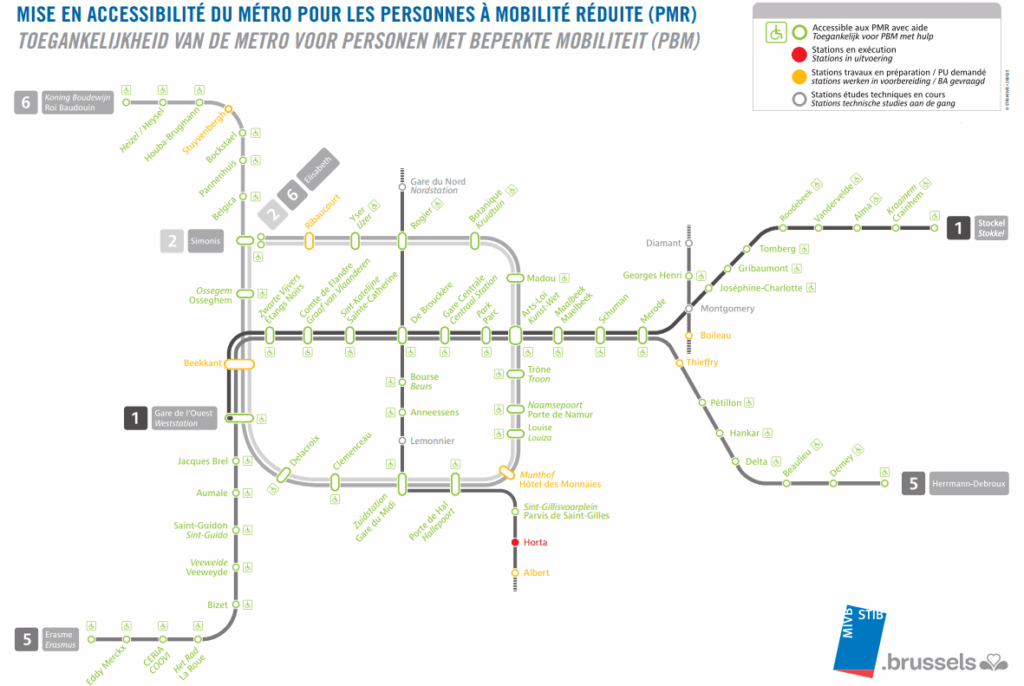
Brussels Mobility is responsible for installing lifts in metro and pre-metro stations. The Brussels metro network currently has 69 stations.
- 55 stations have lifts
- 5 stations are currently being equipped with lifts
- 3 stations are in preparation (permit requested or granted)
- Studies are under way for 6 stations
Surface stops (bus and tram)
STIB-MIVB serves more than 2,000 stops across the Brussels region. Today, about half of the 2,223 surface stops are accessible with assistance, and more than 1 in 5 are fully independently accessible.
Stop management is constantly evolving and is based on 3 pillars:
- Providing information on stop accessibility
- Maintenance and upgrades of existing stops
- New stops
STIB-MIVB has developed a standards plan that serves as the reference for managing the entire system. It includes numerous elements such as podotactile paving for visually impaired passengers or specific floor tiles for wheelchair users, helping them identify which door offers the easiest access.
Through the strategic plan, STIB-MIVB commits to upgrading 50 stops per year. The selection is based on a list of priority locations, which serves as a reference for project planning.
In recent years, STIB-MIVB has been replacing recessed stops with better-designed alternatives. At recessed stops, buses must manoeuvre to align with the platform, making parallel alignment difficult. This increases the gap between the platform and the vehicle, which complicates boarding.
For trams, other challenges arise. To bridge the gap between platform and vehicle, and thus improve accessibility, STIB-MIVB developed its own technical solution: a rubber edging fixed to the platform. These rubber platform edges reduce or even completely eliminate the space between tram and platform.
This allows people with limited mobility or wheelchair users to board independently and without difficulty. Combined with raised platforms, this is an innovative solution. Where passengers used to “step on or off” trams, they now simply “walk in or out”! This is essential for wheelchair users but also benefits all other passengers.me, on entre et on sort ! Essentiel pour les personnes en fauteuil, tout bénéfice pour l’ensemble des usagers.
Vehicles
Consistency is important when it comes to accessibility. Ideally, colours should be the same everywhere, buttons should have the same shape, colour and function, and procedures should be similar across the network.
A fully integrated network such as STIB-MIVB’s faces challenges because vehicles range in age from 50 years to just a few weeks.
New M7 metro trains
The new M7 metro trains (2021) are equipped with features that significantly improve accessibility and enable many wheelchair users to board autonomously. This was made possible by a system installed at the doors that reduces the gap between the train and the platform. The height of the M7 also aligns much better with the platform height, eliminating almost all “thresholds”.
In addition to features that assist wheelchair users, the M7 trains include major improvements in audio announcements, colour contrast, and visual indicators for door opening and closing. Written information is also highly legible from anywhere within the M7 train.
Older MX metro trains
Consistency is also important across the metro network. This is why in 2023, the old orange MX trains were upgraded to become “practicable” for wheelchairs. The distinction between “accessible” and “practicable” relates to comfort levels. Some MX trains date back to the opening of the metro in 1976. Bringing them up to the M7 standard is simply impossible.
STIB-MIVB of course aims to offer the most consistent travel experience possible. This work is far from complete, and in the future, we will focus on informing passengers so they can enjoy the best possible experience. These principles also apply to the M6 metro trains, which are currently being studied for full upgrades.
In addition, within the strategic plan framework, STIB-MIVB is examining how to improve accessibility across different generations of metro trains, with the goal of standardising boarding in the middle of the train, reducing the gap between platform and metro as much as possible. Today, wheelchair users board an M7 in the middle, while on other trains they board at the front or rear.
Trams
Naturally, the old (PCC-type) trams with high steps cannot accommodate wheelchair users. However, STIB-MIVB still needs these trams to maintain its overall service offer, but adapts them wherever possible –for example, by adding audio announcements and gradually replacing old destination signs with clear digital displays.
The more recent low-floor trams (types T3000 and T4000, representing 55% of the tram fleet) have undergone technological upgrades completed in 2020. These include door adjustments to make them compatible with the rubber platform edges.
Because installing rubber platform edges takes several years and can be complex at certain stops, STIB-MIVB equipped all T3000 and T4000 trams with portable ramps in 2023. These ramps are located in the multifunctional area at the second door and may be used by passengers or STIB-MIVB staff assisting wheelchair users.
When purchasing the new TNG-type tram, technical requirements obviously included platform-vehicle gap reduction. At fully accessible stops, passengers can board this type of tram smoothly. These trams also have an integrated ramp and interiors designed with universal accessibility in mind.
Buses
All STIB-MIVB buses are equipped with ramps allowing wheelchair users to board. Ramp reliability was debated for some time, but those days are behind us: since 2022, strict maintenance procedures have guaranteed high availability.
Drivers can also make the bus “kneel”: when a driver notices a passenger is having difficulty boarding (an older person, someone with a pushchair…), they can lower the bus to make boarding easier.
Other solutions for people with disabilities
Assistance in the metro
It is not always possible to board fully independently. Sometimes that is due to the station layout or to the nature of a disability. STIB-MIVB therefore also offers assistance in stations. Service hours were extended in 2023, and reservations are no longer required.
TaxiBus
TaxiBus is a specialised door-to-door public transport service on request. It is intended for people with a recognised disability who cannot use regular public transport. Upon reservation, TaxiBus takes you from your departure address to your destination address.
The service has been available 365 days a year since 2018—including Sundays and public holidays. TaxiBus operates between 5 am and 1 am, just like the standard network.