

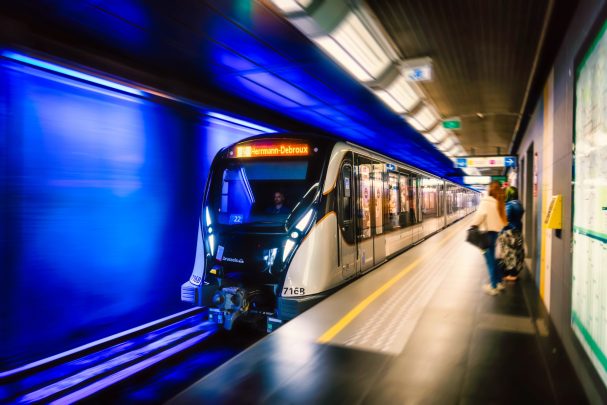
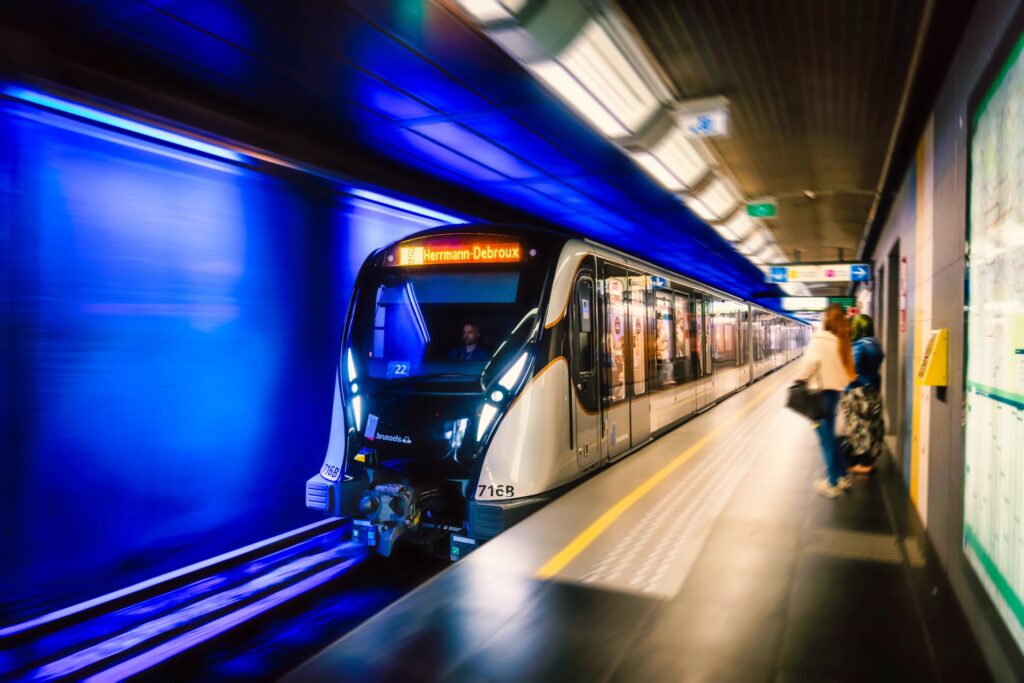
Vous le savez, la STIB modernise son réseau de métro. Pour cela, des nouvelles rames de métro sont entrées Let’s be honest: the metro can be busy, especially during peak hours. The new M7 metro trains, more and more of which are being put into service, are part of the solution. Much less visible, but just as important, is the major renewal of our signalling system with a new technology: CBTC (Communication-Based Train Control). Thanks to this modernisation, we’ll be able to run more metro trains, reduce waiting times, and offer more space and comfort. Here’s how.
A 50-year-old network with a robust system
Our metro network is 50 years old and was equipped at the time with a highly modern signalling system. This system divides the metro network into fixed zones, with a maximum of one train per zone. It is a very effective safety system: thanks to these zones (formed by track circuits), one metro train can never overtake another. Each train always keeps a fixed minimum distance from the one in front. If that distance is not respected, the train is automatically slowed down.
Metro congestion
The downside of the current system? It works with large, fixed distance zones. As a result, we cannot reduce the waiting time or interval between two metro trains below 2 minutes 30 seconds. With the old signalling system, we already reach maximum capacity during peak hours on the busiest section of the network: the shared section of lines 1 and 5.
We could buy as many metro trains as we want, it would make no difference as long as we cannot reduce the interval. That would only create “metro congestion”. This is why new signalling is essential.
The solution: CBTC (Communication-Based Train Control)
The new signalling system is called CBTC (Communication-Based Train Control). CBTC combines radio communication between trains and equipment installed along the tracks and in technical rooms. Thanks to this technology, the current fixed zones can be replaced by variable – and therefore much smaller – zones.
This makes it possible to reduce the safety distance between trains and, as a result, shorten intervals and waiting times. In turn, this allows us to run more trains safely. Overall, this will eventually increase metro capacity by up to 20%!
A metro every 2 minutes
At STIB-MIVB, we are currently testing and rolling out CBTC. In the first phase, we are adapting our existing BOA metro trains and the trackside infrastructure on lines 1 and 5. The new M7 metro trains, of course, are already equipped with CBTC as standard at the factory.
The good news is that within two to three years, metro frequency will increase. Here’s what you can expect:
- A metro every 2 minutes on lines 1 and 5 instead of every 2 minutes 30 today (on the shared section)
- A metro every 2 minutes 30 on lines 2 and 6 instead of every 3 minutes today (on the shared section), or eventually every 2 minutes if passenger numbers allow
We’ve made a video explaining it.
Comfort
Why are lines 1 and 5 being equipped first? Because the shared section of these lines — especially between Merode and Gare Central/Centraal Station— is by far the busiest part of the entire network. It is where higher frequency, capacity and comfort are needed most.
Comfort? Yes. Shorter waiting times mean fewer people on the platform and fewer passengers boarding at the same time. The result: more space on board and therefore greater comfort.
The future metro line 3, which will allow to travel from Evere to Forest/Vorst in 20 minutes, will of course also use CBTC. This ensures a uniform system across the network.
To prepare the rollout properly, we also have a test track at our depot in Haren. This is where we test the signalling system and each new M7 train before it enters service. In particular, we check whether the train “communicates” correctly with the new signalling.
Faster incident management
The system is also more flexible and better able to adapt to real-life conditions. In the event of an incident or delay, the control centre knows exactly where each train is and can react quickly.
Trains can be monitored very precisely and distributed more efficiently, improving the service for passengers. CBTC also offers other possibilities, such as systems for communicating directly with passengers.
“Once installed, the new signalling will offer much greater flexibility and precision in managing metro traffic, thanks to shorter distances between trains and more accurate knowledge of their location,”
explains Marleen Telemans, programme director for metro modernisation.
“For passengers, this will result in more regular intervals, faster resolution of incidents and higher frequencies.”
Towards an automatic metro
In the longer term, CBTC also makes fully automatic metro operation possible, and even a reduction in waiting times to 1 minute 30 seconds. Initially, this could be implemented on the new line 3 or on lines 1 and 5. However, as our CEO Brieuc de Meeûs points out:
“Our first priority is clearly higher frequencies: a metro every 2 minutes on the shared section of lines 1 and 5. Automation can be considered afterwards, but certainly not before.”
Brieuc de Meeûs, CEO of MIVB